Recently, the National Public Service Platform for Standards Information announced“Basic Specifications for Elderly Care Institutions” and “Criteria for Determining Major Accident Hazards in Elderly Care Institutions”two mandatory national standards, which will be implemented on August 1, 2027.
Among them,“Basic Specifications for Elderly Care Institutions”is the first adjustment in 13 years since the standard was implemented on May 1, 2013. The core change is upgrading the “Basic Specifications for Elderly Care Institutions” from a recommended standard to a mandatory national standard. The “Criteria for Determining Major Accident Hazards in Elderly Care Institutions” is the first mandatory national standard issued afterthe release of the “Standards for Determining Major Accident Hazards in Elderly Care Institutions” (Minbanfa [2023] No. 13) in November 2023.
Below are the full texts of the two standards and download links:
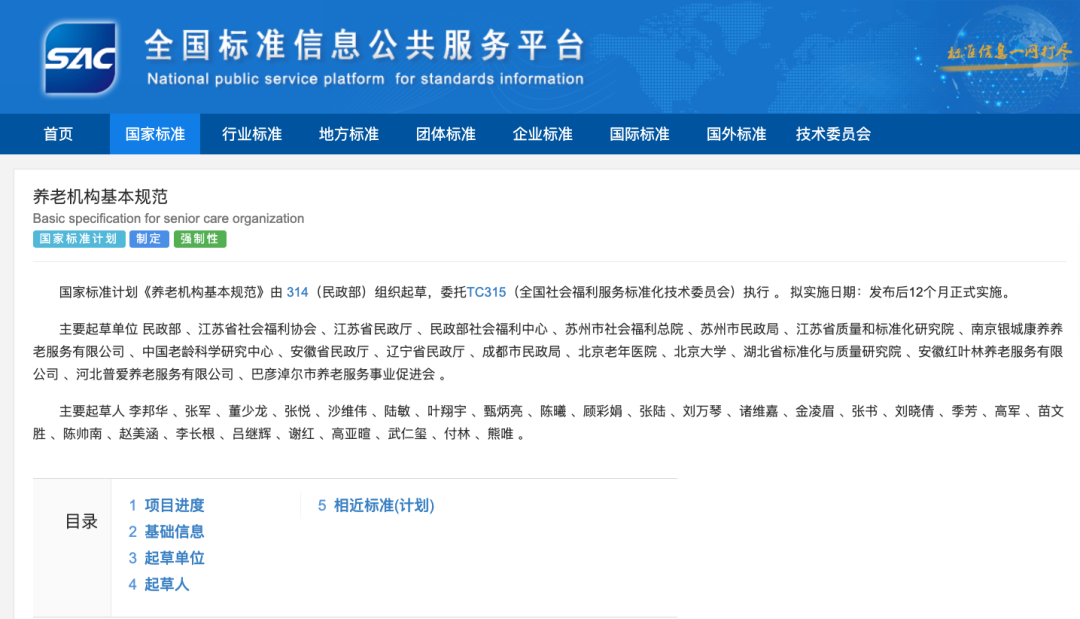
Basic Standards for Elderly Care Institutions
(Click the image to view the full text)
As of the end of 2025, there are 41,700 elderly care institutions in China, but some institutions have issues such as non-standard service procedures, inadequate quality control, and loopholes in safety management. The original recommended standards are difficult to support regulatory authorities in carrying out effective law enforcement supervision. Through this revision, the aim is to change the basic service requirements for elderly care institutions from ‘optional’ to ‘mandatory’,ensuring that elderly people receive more standardized services through mandatory binding force, effectively preventing risks, and promoting the industry’s transformation from ‘voluntary compliance’ to ‘mandatory compliance’.The revised standards will complement standards such as the ‘Basic Safety Standards for Services in Elderly Care Institutions’ to jointly improve the legal system for elderly care services.
Download Link
https://openstd.samr.gov.cn/bzgk/std/newGbInfo?hcno=50EC206EC538AFD35915878F6D70972A
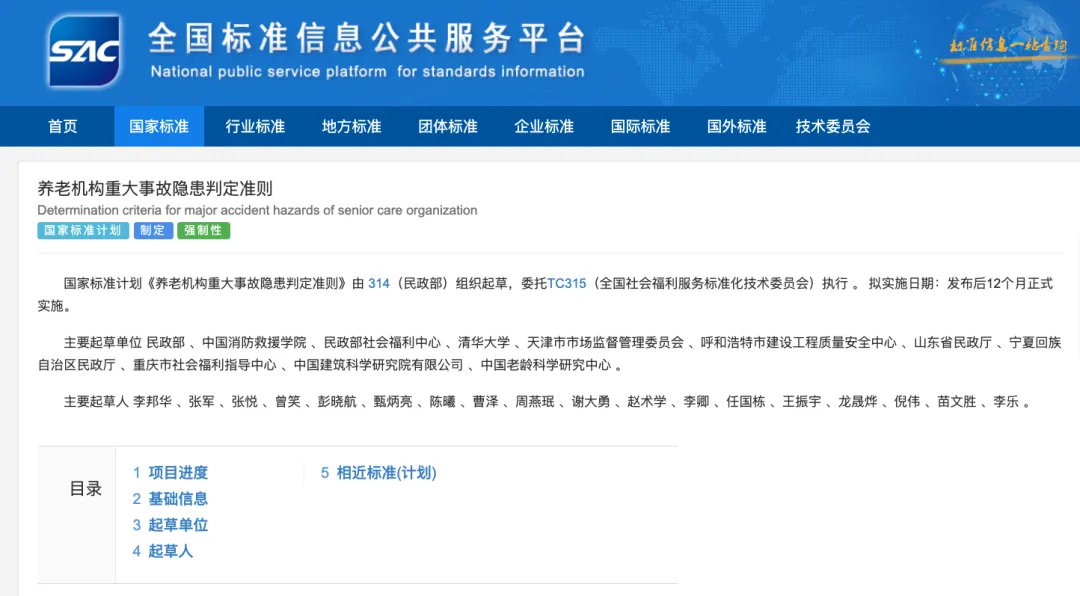
Criteria for Determining Major Hazards in Elderly Care Institutions
(Click the image to view the full text)
The “Criteria for Determining Major Accident Hazards in Elderly Care Institutions” strictly follows the principle of ‘strengthening what should be strengthened and enhancing what can be enhanced,’transforming the most core and critical requirements for determining major accident hazards in the safety field of elderly care institutions into mandatory national standards, filling the gap in the existing standards system and complementing standards such as the “Basic Specifications for Service Safety in Elderly Care Institutions.”At the same time, the implementation of this standard can push elderly care institutions to fulfill their primary safety responsibilities, proactively conduct self-inspection and self-correction of major accident hazards, drive the industry’s transformation from ‘passive rectification’ to ‘active prevention’, further improve regulatory efficiency, effectively reduce the incidence of major safety accidents, decrease casualties and property losses, promote the sustained and healthy development of the elderly care service industry, and maintain social harmony and stability.
Download Link
https://openstd.samr.gov.cn/bzgk/std/newGbInfo?hcno=6740F17AF0CF92B75A13C898AB01683C
|
Source: National Public Service Platform for Standards Information Disclaimer: This platform is dedicated to industry sharing and exchange, and articles do not represent the platform’s views. Copyright belongs to the original authors. If there are any errors in source attribution or infringement of your legitimate rights and interests, please contact us, and we will promptly correct or delete them. Thank you. |
The 9th China Elderly Care Industry Lujiazui Summitwill be held as scheduled on September 15-16, 2026, at the Shanghai International Convention Center. This summit focuses onFour major themes: ‘Keynote Speeches’, ‘Quality Operations’, ‘Long-Term Care Insurance’, and ‘Silver Economy’, featuring practical speeches from over 40 industry experts, expected to attract more than 1,000 industry representatives from various regions, with over 60% being operations management and silver economy decision-makers. This is not a generic industry gathering, but the annual council chamber of core forces.
Eight years of accumulation, worthy of a higher-level reunion.Register now, meet at the summit.