In July of this year, the Ministry of Human Resources and Social Security issued a public notice proposing to list ‘elderly-friendly renovation designer’ as a new occupation. This means that this work, which previously had ‘no name and no status,’ has finally received official recognition at the national level. (Now, the Ministry of Human Resources and Social Security and other departments released 23 new occupations to the public on September 9, including elderly-friendly renovation designer.)
N Solutions for the Bathroom
Home elderly-friendly renovation is harder than expected
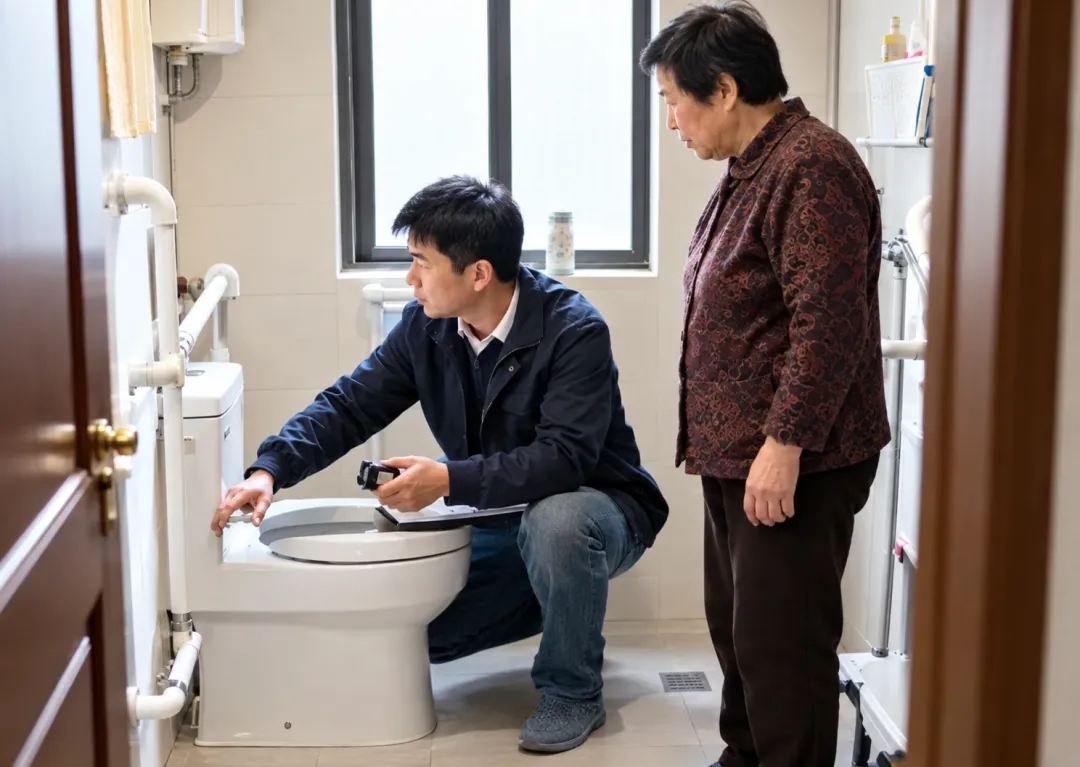
L-shaped and U-shaped grab bars were installed beside the toilet, a foldable shower chair was placed under the showerhead, and slope pads were laid at the bathroom doorway to eliminate height differences… A year ago, at his son’s insistence, the bathroom of Mr. Yu, a resident of Jinan, underwent an ‘upgrade and renovation.’ Although this renovation project was small, it completely changed the elderly man’s experience of using the toilet and bathing. ‘My main problem is that my legs have no strength, and I can’t stand or walk for long periods. With these few items, I can even shower longer than before,’ said Mr. Yu.
The person who proposed renovation suggestions for Mr. Yu’s bathroom was Fan Haiqing, a designer with 6 years of experience in elderly-friendly renovation. In 2020, Fan Haiqing moved from a commercial interior design company to Shandong Yizhen Elderly Care Service Group Co., Ltd., specializing in elderly-friendly renovation design, and currently serves as the company’s design director.
‘Even though they are all elderly-friendly renovations, the design plans for elderly care institutions and home living are very different,’ said Fan Haiqing. Elderly-friendly design plans for elderly care institutions more easily form fixed patterns, analyzing the physical conditions of resident elderly people, designing corresponding spatial patterns in different zones, and equipping them with elderly-friendly products. However, elderly-friendly renovation design for home living requires not only a comprehensive understanding of the elderly person’s physical condition, living habits, and daily movement patterns, but also design and renovation based on the original space of the house, placing higher demands on the designer’s abilities.
Eliminate the height difference at the doorway; a ramp mat can be laid
Taking solving the height difference at the bathroom doorway as an example, bathrooms in elderly care institutions generally have basic standards, and whether building a new ramp at the doorway or removing the threshold, neither is difficult. However, the home bathroom environment is more complex. Many elderly people’s homes were built in the 1980s and 1990s, and bathroom and hallway spaces are limited, so many conventional solutions cannot be copied directly. ‘We have encountered situations where the passage in front of an elderly person’s bathroom was too narrow to lay a ramp, so we changed our approach. When the elderly person could still move their legs reasonably well, we added a vertical grab bar at the bathroom doorway to help them lift their legs when stepping into the bathroom,’ said Fan Haiqing.
Qi Juntao, head of Shandong Youdian Health Industry Co., Ltd. (abbreviated as ‘Youdian Care’), also has deep feelings about the complexity of home aging-in-place renovations. ‘We have undertaken the construction of home-based elderly care beds in many places, and almost all are one household, one plan. Spatial renovations and the provision of aging-friendly products must be based on the specific circumstances of the elderly person,’ Qi Juntao said. Detailed in-home assessment and research are an important foundation for carrying out aging-friendly renovations, and this tests the assessors’ physical stamina, observation skills, and mental acuity.
No directly corresponding major
Practitioners in aging-friendly renovation come from a wide range of backgrounds
In contrast to the growing demand for aging-friendly renovations, at present there are almost no colleges or universities in China offering majors related to aging-friendly renovation design, which also results in practitioners in this field coming from a wide range of backgrounds, with most having never received systematic education.
This can also be seen from the career experiences of Fan Haiqing and Qi Juntao. Fan Haiqing majored in interior design in university. After graduation, she found a job related to her major, mainly undertaking interior design work for workplaces such as hotels and office buildings. In 2020, due to a chance opportunity, she entered the field of aging-friendly renovation design. Although she was still doing design work, many aspects had changed.
‘I had never been exposed to aging-friendly renovation design before, so I started learning from the national standard Code for Design of Residential Buildings for the Elderly,’ Fan Haiqing recalled her self-study process. She first carried out design planning in accordance with national standards, learning while working, and accumulated preliminary experience. Then she participated in industry exchanges, gaining more knowledge about aging-friendly renovation design by exchanging experience with frontline practitioners. Finally, Fan Haiqing also subscribed to the official accounts of domestic experts in elderly architectural design, following and learning from various courses and lectures posted there over the long term.
Fan Haiqing subscribed to the official account of a domestic expert in elderly-oriented architectural design.
Fan Haiqing is undoubtedly one of the typical representatives of age-friendly renovation practitioners. At present, many architectural or interior designers, seeing the market potential of age-friendly renovation, actively choose to change careers and enter this new field. Thanks to their design foundation, they can get up to speed relatively faster in their transition and can better adapt to the needs of customized design solutions, but they still need to learn a large amount of professional content such as the physiological and psychological characteristics of the elderly and the parameters of age-friendly products.
In addition to practitioners from design backgrounds, many others come from related fields such as elderly care and rehabilitation medicine. Qi Juntao originally worked in community elderly care services. During long-term care for the elderly, he keenly discovered that the elderly care field had increasingly high requirements for age-friendly environments, yet could not find professional service teams to connect with, so he gradually led his team to expand this business segment. ‘We mainly undertake the construction of family elderly care beds, which have relatively clear requirements for age-friendly renovation, and the renovation can be carried out in combination with the requirements listed in the project list and the feelings of the elderly,’ Qi Juntao said.
Practitioners from different backgrounds have brought diverse experience, and have also led the industry to form a growth path of ‘exploring through practice while accumulating and summarizing.’ Many practitioners admit that industry knowledge mostly comes from accumulated hands-on project experience. The needs of different families vary greatly, and only by encountering more individual cases can more practical design experience be summarized.
The homes of 300 million elderly people
need more professionals to ‘diagnose and prescribe’
Although orders for age-friendly renovation are growing year by year, in Fan Haiqing’s view, China’s age-friendly renovation market is still in its initial stage. Against this backdrop, people can accumulate experience through ‘learning by doing and doing while learning,’ and then complete renovation orders. However, as the demand for age-friendly renovation becomes broader and broader, ‘self-taught success’ will find it difficult to meet real-world needs. Many industry insiders also admit that without receiving professional and systematic training, designers will inevitably have a fragmented capability of ‘understanding design but not elderly care, and understanding elderly care but not design.’
In terms of talent cultivation, some explorations have already begun. Suzhou Art & Design Technology Institute established the first industry college for age-friendly design among domestic higher vocational colleges in 2023. In April of this year, the third training class for age-friendly environment improvement engineers, jointly organized by the Qingdao Intelligent Rehabilitation Assistive Devices Association and the Beijing Rehabilitation Assistive Devices Association, was held in Qingdao, dedicated to cultivating professionals with three core competencies: assessment of functional impairment in older adults, scientific adaptation of age-friendly assistive devices, and design of home age-friendly solutions.
Now, giving official recognition to age-friendly renovation designers at the national level has also injected a boost of confidence into relevant practitioners. ‘In the future, if unified occupational standards and training specifications can be introduced, we will be able to improve our professional capabilities with clearer direction, ultimately allowing older adults to enjoy more thoughtful design services,’ said Fan Haiqing.
|
Source: Dazhong Daily Disclaimer: This platform is dedicated to industry sharing and exchange, and articles do not represent the views of the platform. Copyright belongs to the original author. If there is an error in the source attribution or infringement of your lawful rights and interests, please contact us, and we will promptly correct or delete it. Thank you. |