Smart Assistive Devices, Better Living | From National Major Application Scenarios, How the Elderly Care and Disability Assistance Industry Is Reaching People’s Doorsteps
How can an exoskeleton help elderly people with limited mobility walk more steadily? How can a caregiving robot be integrated into the daily services of elderly care institutions? What thresholds must a smart rehabilitation assistive device cross to move from a new product on the exhibition stand into ordinary households?
These questions are becoming important propositions for the development of the elderly care and disability assistance industry.
On October 20, 2026, the National Development and Reform Commission held a press conference to introduce policies on developing new quality productive forces and improving the price formation mechanism for inclusive elderly care services, as well as reform measures such as scenario cultivation and opening and market-based allocation of factors.Information released the same day shows thatthe National Development and Reform Commission and five other departments launched the first batch of 136 landmark major application scenario projects to provide support for innovative achievements moving toward large-scale application.
Among them,the ‘Industrialization Scenario Construction Project for Smart Rehabilitation Assistive Devices in the Field of Elderly Care and Disability Assistance’ submitted by the Ministry of Civil Affairs was included in the first batch list, with the National Research Center for Rehabilitation Technical Aids leading its organization and implementation.
By linking policies, projects, and industrial practice, a clear development path becomes visible:Let real demand drive technological innovation, let application validation promote product maturity, and let service networks deliver innovation outcomes to the people.
01
Let technology
be tested in real life
The first batch of 136 projects covers five major categories: new fields and new tracks, industrial transformation and upgrading, industry-sector applications, social governance services, and livelihood fields, involving more than 1,700 new technologies, more than 1,200 new products, and more than 2,200 new standards and specifications. Relevant projects will provide participation opportunities for private enterprises and small and medium-sized enterprises by publicly releasing lists of technologies, products, and business formats to be validated; subsequent projects will also be rolled out on a rolling basis, and mature experience will be summarized and promoted.
These arrangements place technology application, enterprise participation, standards development, and institutional improvement on the same chain.
For the field of elderly care and disability assistance, this point is especially critical. Performance in the laboratory needs to be further translated into convenience in older adults’ daily use; the fact that a product can complete a certain action still requires examining whether it suits specific users, whether it can be integrated into care processes, and whether maintenance costs are affordable.
At the press conference, the National Development and Reform Commission summarized the related tasks as verification, opening up, and demonstration, emphasizing the testing of technical reliability, facility adaptability, economic feasibility, and institutional adaptability in real-world scenarios.
From this, it can be understood that the value of application scenario development lies in enabling developers, service providers, and users to jointly participate in product improvement. Feedback from a single real-world use may change the position of a button or the design of a feature, and may also drive adjustments to the entire service process.
02
Intelligent Rehabilitation Assistive Devices
How to successfully navigate the ‘last mile’ of application
By the end of 2025, there were approximately 240,000 market entities related to rehabilitation assistive devices in China, with more than 10,000 types of products circulating in the market, and the industry scale exceeding 730 billion yuan. Products such as exoskeletons, brain-controlled prosthetics, elderly care robots, and smart wheelchairs also present various possibilities for integrating technologies such as artificial intelligence and brain-computer interfaces with the needs of elderly care and disability assistance.
At the same time, the increase in product variety has also placed higher demands on service capabilities. In the face of different ages, different physical conditions, and different living environments, how to assess needs, select products, guide use, and provide ongoing maintenance directly affects whether assistive devices can function effectively.
The selected project proposes building a two-tier service network consisting of ‘intelligent rehabilitation assistive device city reception halls + community nearby service outlets’: city reception halls focus on display and experience, product verification, assessment and fitting, technical training, and supply-demand matching; community outlets provide basic services such as simple fitting, rental and maintenance, and usage guidance.
This design combines professional expertise with service accessibility.
City-level hubs can help enterprises validate products, train personnel, and develop service solutions; community outlets make it easier for those in need to learn about assistive devices, obtain fitting guidance, and find service support during use.
Judging from the construction logic presented in the video, products and services extend toward users, and user feedback also returns to the R&D and manufacturing side, forming a cycle of continuous improvement. Around this cycle, policy, regulation, payment guarantees, finance and insurance, talent, and digital capabilities all need to work together in support.
The industrialization capability of assistive devices is reflected in every link of manufacturing, fitting, delivery, and long-term service.
03
Technology Implementation and Affordable Elderly Care
We need to jointly answer the question of whether people can afford to use it
This press conference also introduced the Guiding Opinions on Further Improving the Price Formation Mechanism and Promoting the Quality and Expansion of Affordable Elderly Care Services.
The Guiding Opinions distinguish between basic-guarantee, inclusive-support, and fully market-based elderly care institutions, improve fee management methods by category, and require the establishment of fee catalogs and the public disclosure of service content and fee standards. At the same time, through supportive measures such as facility renovation, equipment upgrading, and site provision, they promote the expansion of inclusive service supply.
Linking this policy with the application of smart rehabilitation assistive devices reveals a resonance in their objectives: technological progress enhances service capacity, while pricing mechanisms and supporting measures promote service accessibility.
For elderly care institutions, introducing smart devices requires a comprehensive assessment of the costs of procurement, training, maintenance, and ongoing operation; for older adults and their families, whether services are clear and transparent and whether expenses are affordable also affects their willingness to use them.
Therefore, evaluating an application of elderly care technology can examine three outcomes at the same time: whether users benefit, whether care work is improved, and whether services can be provided sustainably. The payment, subsidy, and fee arrangements for specific assistive devices still need to be determined in accordance with the corresponding policies and local implementation rules.
04
Shanghai Elderly Care Expo
Where industrial innovation meets daily life needs
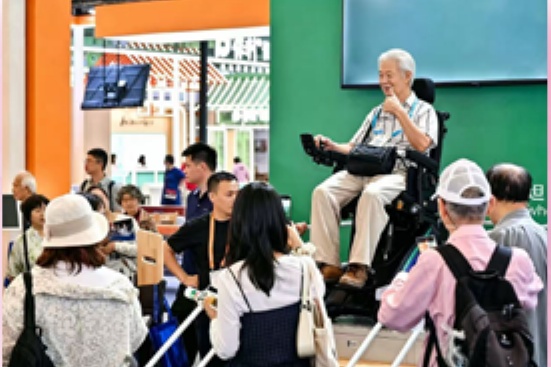
Observing how smart rehabilitation assistive devices reach users, the Shanghai Elderly Care Expo provides a vivid window.
The Shanghai International Exhibition of Senior Care, Rehabilitation Medicine and Healthcare, abbreviated as ‘Shanghai Elderly Care Expo’ (AID), is jointly hosted by the Shanghai Civil Affairs Bureau and the Shanghai Council for the Promotion of International Trade. Since its founding in 2000, it has continued to build a platform for showcasing and exchanging age-friendly products, services, and technologies. The 2026 exhibition will be held from June 4 to 6 at the Shanghai New International Expo Centre, with an exhibition area of 60,000 square meters, gathering nearly 680 exhibitors from 22 countries and regions.
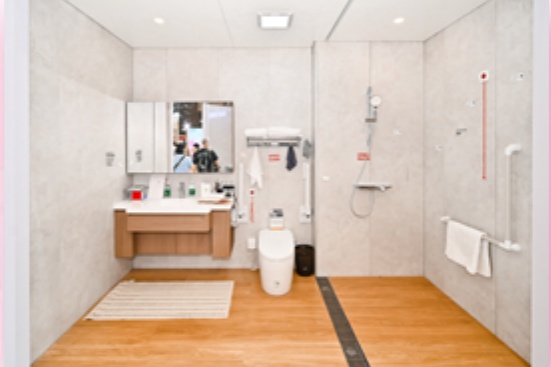
From rehabilitation aids and smart elderly care to age-friendly renovation and community home-based services, the exhibition places products within specific life needs. The 2026 exhibition features a Rehabilitation Aids Innovation Zone, showcasing smart elderly care technologies and solutions, and presenting diverse scenarios such as home rehabilitation and elderly care services.
This also reflects the connection between professional exhibitions and scenario building: exhibitions give new products centralized opportunities for display and experience, allowing enterprises to encounter demand, institutions to compare solutions, and users to express their feelings; afterward, products still need to enter communities, homes, and institutions to continue being validated and refined in daily use.
From this perspective, the Shanghai Elderly Care Expo can become an important platform connecting industrial supply with actual demand. An experience or a conversation at an exhibition booth has the chance to become the starting point for subsequent product improvement, service cooperation, and application implementation.
Turning innovation outcomes
into sustainable service capacity
Taken together, these materials suggest that the next stage of development for the elderly care and disability assistance industry requires further connecting several links.
On the R&D side, there should be a more detailed understanding of the daily difficulties faced by specific groups of people, incorporating ease of use, functional adaptability, and maintenance needs into the design.
For institutions and communities, they can start with high-frequency, clearly defined needs, organize product experience, assessment and configuration, usage training, and after-sales service, and continuously record actual usage outcomes.
Among exhibitions, research institutions, manufacturing enterprises, and service organizations, more stable cooperation can be formed around needs publication, product validation, personnel training, and feedback-driven improvement, allowing innovative achievements to mature continuously through real-world use.
This is also a concrete manifestation of developing new quality productive forces in the field of elderly care and disability assistance: through the joint progress of technology, services, and organizational approaches, improving service quality, expanding the scope of application, and enabling more people to share the convenience brought by innovation.
When smart assistive devices enter communities, homes, and institutions, what they carry is a easier rise from a seat, a safer journey, and a more relaxed life for the whole family.
Let technology respond to specific difficulties, and let services reach those in need, so that ‘smart assistive devices, better living’ can become a tangible part of daily life.
|
Source: Compiled from information on online platforms Disclaimer: This platform is dedicated to industry sharing and exchange, and the articles do not represent the views of the platform. Copyright belongs to the original authors. If there are errors in source attribution or infringement of your legitimate rights and interests, please contact us, and we will promptly correct or delete the content. Thank you. |